

Finance Act 2026 Pakistan: Key Tax Changes for Businesses

Understand the key income tax, sales tax, withholding and digital compliance changes introduced through Pakistan’s Finance Act 2026. Pakistan Finance Act 2026: Key Tax Changes Every Business Owner Should Know Pakistan’s Finance Act 2026 introduces several important tax and compliance changes affecting companies, exporters, service providers, wholesalers, retailers, e-commerce businesses, professionals and individual business owners. While the Finance Act provides relief in selected areas, it also continues a broader shift towards digital tax administration, electronic invoicing, data matching and stronger documentation requirements. For businesses, this means tax compliance can no longer be viewed only as an annual return-filing exercise. Accounting records, bank transactions, invoices, withholding taxes, sales tax returns and financial statements increasingly need to tell the same story. Below are some of the key changes introduced through the Finance Act 2026 Pakistan and their practical implications for businesses. Key Finance Act 2026 Changes at a Glance Area Key Change Business Impact Export taxation Overall tax collection on export proceeds reduced Improved cash flow for exporters IT & IT-enabled services Concessionary tax rate extended Greater certainty for qualifying IT exporters Super tax Rates rationalised Potential reduction in tax burden for larger businesses Withholding tax Rates and categories revised Businesses need to update withholding matrices E-commerce Adjustability allowed in specified cases Better treatment for certain documented sellers FBR integration Greater emphasis on electronic integration Accounting and ERP systems may require upgrades Banking data Greater use of transaction data for tax analysis Bank and tax records must be properly reconciled Property taxation Certain taxes rationalised Reduced tax friction in qualifying transactions Sales tax Electronic monitoring expanded Higher documentation and reconciliation requirements Financial reporting Movement towards machine-readable reporting Accounting data quality becomes increasingly important 1. Reduced Tax Collection on Export Proceeds One of the important measures under the Finance Act 2026 relates to taxation of export proceeds. The overall tax collection applicable to certain export proceeds has been reduced from the previous combined level, providing some relief to exporters. What does this mean for exporters? For export-oriented businesses, lower tax collection at source may improve working capital and cash flow. However, exporters should still ensure that: Export invoices are properly documented. Foreign proceeds are received through prescribed banking channels. Bank receipts agree with export invoices. Foreign remittance documentation is maintained. Export income is correctly reported in the income tax return. Applicable federal and provincial tax requirements are separately considered. Businesses should not assume that a lower withholding or advance tax rate automatically eliminates other tax or documentation requirements. A proper reconciliation between export invoices, bank receipts and income reported in the financial statements remains essential. 2. Tax Relief for IT and IT-Enabled Service Exporters The concessionary tax regime available to qualifying exporters of IT and IT-enabled services has been extended, providing greater certainty to Pakistan’s technology and outsourcing sector. This is particularly relevant for: Software companies IT service providers Business process outsourcing companies Technology consultants Digital service businesses Certain freelancers and professional service exporters Eligibility still matters Simply earning income from foreign clients does not automatically mean that a business qualifies for a concessionary tax rate. IT and IT-enabled service exporters should review: Nature of services provided Registration requirements Foreign client agreements Export invoices Banking channels used for receiving proceeds Foreign remittance certificates Income tax return disclosures Withholding tax compliance For technology businesses, proper documentation is becoming almost as important as the availability of the tax concession itself. 3. Super Tax Has Been Rationalised The Finance Act 2026 has also introduced changes to the super tax regime applicable to higher-income taxpayers. The changes provide relief to certain businesses while maintaining separate treatment for specified sectors. Why businesses should review this now Companies falling within or close to the relevant income thresholds should reassess: Estimated annual taxable income Advance tax calculations Current tax provisions Deferred tax implications Cash-flow forecasts Financial projections Business valuations It is important to remember that accounting profit and taxable income are not necessarily the same. Taxable income may be affected by depreciation, inadmissible expenses, tax credits, brought-forward losses, exemptions and other adjustments. Businesses should therefore assess super tax based on a proper tax computation rather than applying the rate directly to accounting profit. 4. Withholding Tax Rates and Categories Require Review Withholding tax continues to be one of the most important areas of tax compliance for businesses in Pakistan. The Finance Act 2026 introduces changes affecting the taxation and classification of various services and payments. Businesses making payments to the following should review their withholding treatment: Consultants Accountants Lawyers IT service providers Marketing agencies Contractors Freelancers Technical specialists Professional service providers Suppliers and vendors What should businesses update? Every business should maintain an updated withholding tax matrix covering: Nature of payment Relevant tax provision Applicable withholding rate Taxpayer status of the supplier ATL status, where relevant Exemption or reduced-rate certificates Treatment of sales tax Filing and payment deadlines Continuing to use the previous year’s withholding rates without review can result in: Short deduction of tax Excess deduction from suppliers Penalties Default surcharge Supplier disputes Disallowance of expenses in certain circumstances Withholding tax rates should therefore be reviewed at the start of every financial year and updated in the accounting or ERP system. 5. Changes Affecting Distributors, Dealers and Wholesalers Businesses operating in distribution and wholesale sectors should also review the Finance Act 2026 carefully. Changes to minimum tax and withholding regimes can have a significant effect on businesses operating with high turnover but relatively low margins. This may include businesses involved in: Distribution Wholesale trading Consumer products Pharmaceuticals Industrial supplies FMCG Electronics Other trading activities Even a small increase in a turnover-based tax can materially affect profitability when annual sales are substantial. Key areas to review Distributors and wholesalers should reconsider: Annual tax forecasts Advance tax payments Gross and net margins Supplier rebates Discounts Incentives Minimum tax exposure Documentation requirements Principal and distributor agreements Tax should therefore be incorporated into pricing and margin analysis rather than considered only after year-end. 6. Important Changes for E-Commerce Businesses Pakistan’s e-commerce tax
Leveraging Fractional CFO Services for Scaling Startups
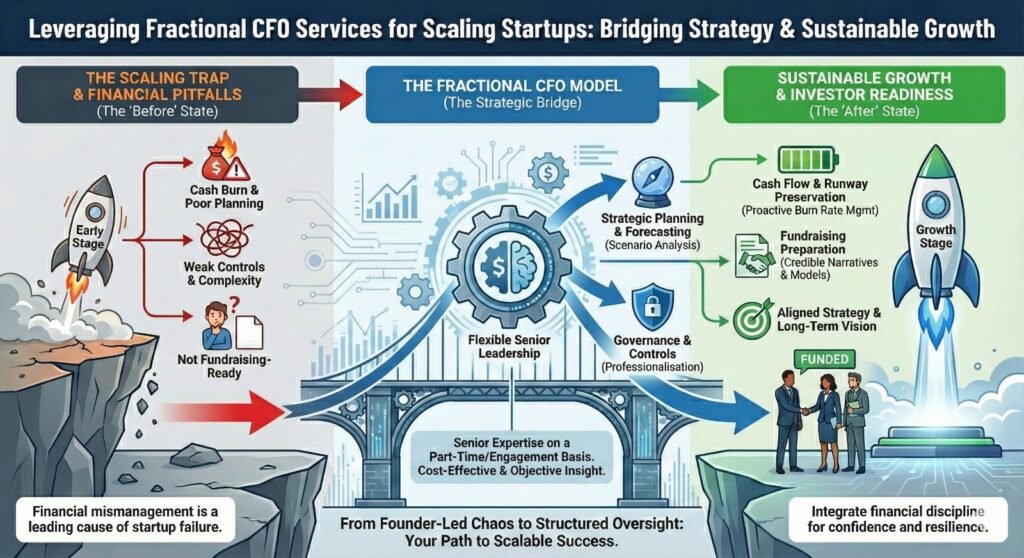
How Strategic Financial Leadership Supports Fundraising and Sustainable Growth Introduction Scaling a startup is an inherently complex process, marked by rapid decision-making, constrained resources, and heightened expectations from investors and stakeholders. While founders often focus on product development and market expansion, financial discipline and strategic oversight frequently determine whether growth is sustainable or short-lived. Empirical research consistently shows that financial mismanagement is a leading cause of startup failure. A significant proportion of startups fail not due to lack of innovation, but because of inadequate cash flow planning, weak financial controls, and insufficient readiness for fundraising processes¹1. As startups progress beyond the early stages, the need for experienced financial leadership becomes increasingly critical. In this context, fractional Chief Financial Officer (CFO) services have emerged as a practical and effective solution. Fractional CFOs provide senior-level financial expertise on a part-time or engagement basis, enabling startups to access strategic financial leadership without the cost and rigidity of a full-time executive appointment. Understanding the Fractional CFO Model A fractional CFO is an experienced finance professional who performs the responsibilities of a traditional CFO on a flexible, non-permanent basis. Unlike a full-time CFO, a fractional CFO is engaged for a defined scope, duration, or number of days per month, depending on the organisation’s needs. This model is particularly well-suited to startups and growth-stage companies that require high-level financial input but are not yet positioned to justify a full-time CFO role. Fractional CFOs typically bring prior experience from established corporations, professional services firms, or multiple startup environments, allowing them to apply proven financial frameworks across different business contexts². From a governance perspective, fractional CFOs operate as independent advisors, providing objective financial insight while working closely with founders and senior management to strengthen financial decision-making. Why Financial Leadership Is Critical During the Scaling Phase As startups transition from early traction to scale, financial complexity increases significantly. Revenue models evolve, cost structures expand, and external stakeholders such as investors, lenders, and regulators demand higher levels of financial transparency. Key challenges commonly faced during this phase include: Without experienced financial leadership, startups risk making growth decisions that are not supported by underlying financial capacity. Fractional CFOs address this gap by embedding financial discipline into strategic planning. Core Benefits of Fractional CFO Services for Startups Recruiting a full-time CFO represents a significant financial commitment, often involving substantial fixed remuneration and long-term contractual obligations. Fractional CFO services allow startups to access equivalent expertise at a materially lower cost by paying only for the level of involvement required³. This cost efficiency enables startups to deploy capital more strategically, particularly during periods where cash preservation is essential. Recruiting a full-time CFO represents a significant financial commitment, often involving substantial fixed remuneration and long-term contractual obligations. Fractional CFO services allow startups to access equivalent expertise at a materially lower cost by paying only for the level of involvement required³. This cost efficiency enables startups to deploy capital more strategically, particularly during periods where cash preservation is essential. Fractional CFOs play a central role in translating business strategy into financial plans. This includes developing integrated financial models that link revenue drivers, operating costs, capital expenditure, and funding requirements. Through scenario analysis and sensitivity modelling, founders gain visibility into the financial implications of strategic decisions, such as entering new markets, hiring senior talent, or adjusting pricing strategies. Effective cash flow management remains one of the most critical success factors for startups. Fractional CFOs introduce structured cash forecasting, typically through rolling short-term and medium-term cash flow models, enabling proactive decision-making. By closely monitoring burn rates and liquidity positions, fractional CFOs help startups identify potential funding gaps early and take corrective action before financial stress emerges⁴. One of the most impactful contributions of a fractional CFO is in fundraising preparation. Investors expect startups to present coherent financial narratives supported by credible assumptions, historical data, and forward-looking projections. Fractional CFOs support this process by: A well-prepared finance function significantly improves investor confidence and can positively influence both the speed and quality of fundraising outcomes⁵. As startups grow, informal financial processes often become inadequate. Fractional CFOs assist in establishing appropriate governance structures, internal controls, and financial reporting frameworks proportionate to the organisation’s size and complexity. This professionalisation not only supports internal decision-making but also aligns the organisation with expectations of external stakeholders, including institutional investors and regulatory bodies. When Should a Startup Consider a Fractional CFO? While there is no universal threshold, startups typically benefit from fractional CFO services when they reach one or more of the following stages: Early engagement often prevents financial issues from compounding as the business scales. Conclusion Fractional CFO services represent a pragmatic and increasingly adopted approach to financial leadership for scaling startups. By combining strategic insight, financial discipline, and operational flexibility, fractional CFOs enable startups to navigate growth with greater confidence and resilience. Rather than viewing finance as a back-office function, successful startups integrate financial leadership into their strategic core. Access to experienced CFO-level expertise, even on a fractional basis, can materially enhance decision quality, investor readiness, and long-term sustainability. Startups seeking to professionalise financial operations and strengthen their growth foundations may consider external CFO expertise as part of their broader strategic planning framework. Disclaimer – This article is for general informational purposes only and does not constitute professional advice. Readers should seek professional guidance tailored to their specific circumstances before making financial or strategic decisions. References (Endnotes)